
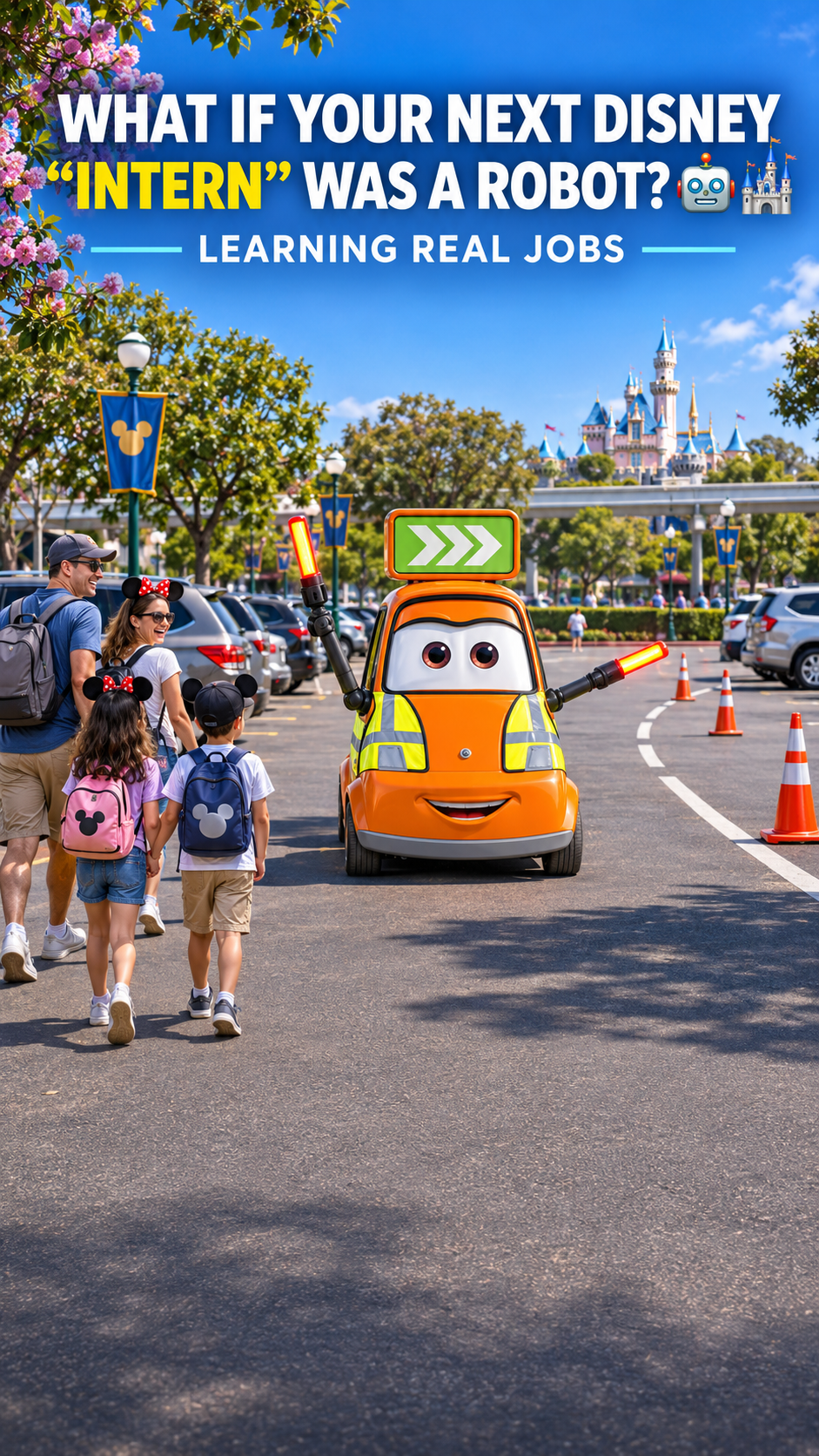
Imagine arriving at a Disney park and seeing a robot helping guide cars. Backstage, another robot carefully arranges the 3D glasses used by guests.
Disney is exploring both ideas. They offer an interesting glimpse of robotics: machines learning to help with everyday work.
What is Disney testing?
At its Accelerator Demo Day on 3 November 2026, Disney highlighted two collaborations.
FieldAI is exploring robots that could support parking operations. Physical Intelligence, also known as Pi, is working with Walt Disney Imagineering on handling and arranging 3D glasses for cleaning between shows.
These are exploratory projects, not an announcement that robot assistants will greet every visitor.
CNET reported that Pi’s team spent 12 nights at Disneyland collecting data and testing the backstage work. One team member described the experience as a “robot internship”.
Everyday tasks require real skills
These tasks may feel familiar to people, but they involve constant judgement.
A person can recognise that a pair of glasses is upside down. A parking attendant can notice a hesitant driver or a pedestrian changing direction.
For a robot, recognising those changes and choosing an appropriate action is a substantial challenge. It needs to understand its surroundings, handle objects carefully and respond when conditions change.
The work itself deserves respect. Familiar does not mean easy.
Practice helps—but people still matter
The “intern” comparison is useful, with limits. Robots do not learn exactly as people do, and a mistake does not automatically teach a robot the right answer.
Engineers collect examples, train systems, test their behaviour and make improvements. Working around real objects can reveal problems that a carefully arranged demonstration misses.
People must still decide when a system is ready, what it may do and when to intervene.
Reliability is the real achievement
An impressive performance is exciting. Dependable assistance means doing the task well repeatedly, including when something unexpected happens.
The bigger question is: Can robots become safe and reliable enough to help people with everyday work?
Parent–child discussion: If you trained a robot helper, what would it need to demonstrate before you trusted it to work around other people?